Category Archives: Daily Post

Divorced, Dead or Different?

Today during introductions, someone mentioned that they had just gotten married and that started a discussion about the difference between the words geheiratet and verheiratet. Both of these are past participles, from heiraten and verheiraten respectively, however verheiratet can also be used as an adjective and it is out of this difference that our discussion arose. Thus, one can say Ich bin verheiratet – I am married – but if you are trying to describe the event, say because it just happened as in this woman’s case, you need to say Ich habe am neunzehnte Januar geheiratet – “I got married on 19 January” – and not Ich war am neunzehnte Januar verheiratet, as the latter implies that between then and now you ceased to be married – “I was married on 19 January (but now I am not).” An extra added twist is that the non-reflexive verb verheiraten means “to marry someone off;” if you want to talk about your own marriage, you need to use the reflexive form sich (mit jemandem) verheiraten Ich habe mich am 19 Januar verheiratet. (Note that sich verheiraten and verheiraten [and heiraten] both take haben in the past tense, therefore you have another clue to use when trying to decide whether verheiratet is being used as an adjective or a past participle.)

If this wasn’t enough confusion, what popped into my head was how different the relationship was between geschieden and verschieden: Ich bin geschieden – “I am divorced” – and Ich bin verschieden – “I am different.” Although verschieden is the past participle of verscheiden, it is very unlikely to be interpreted in this way as verscheiden is a polite or euphemistic form of the verb “to die.”

Tagged , , , , ,

Success by Going With the Flow?

die Leistung – “performance, achievement, accomplishment”
die Leitung – “conduct, administration, line” (as in conduit or pipe) compare Leitung einer Firma, “direction of a company” and Leitung einer Flüssigkeit, “conduction of a liquid”

I’d used the second word to be very North American and order tap water in a restaurant – Leitungswasser – and upon learning its near sound alike, die Leistung, I immediately wondered what you would get if you ordered “performance water?”

Tagged , ,

Of Owls and Spoons

Last week we were discussing Redewendungen – “idiomatic expressions” – and the phrase die Suppe auslöffeln was one that I had previously heard. Literally it means “to eat up all of the soup” but the figurative meaning can be translated as “to face the music” or “to face the consequences” – die Konsequenzen/Folgen tragen. This led me to other phrases including the verb tragen, some of which feel quite natural in English, others less so. Prior to learning the idiom die Suppe auslöffeln, I’d used this verb mainly in the sense of “wearing” something as in “to wear a coat” – einen Mantel tragen. Here are some expressions and saying that extended the meaning of tragen for me:

“to carry a trunk” – einen Koffer tragen
“to bear a name” – einen Namen tragen
“to pay for itself” – sich selbst tragen

“to grin and bear it” – es mit Fassung tragen (“to bear something with composure”)
“to bring coals to Newcastle” – Eulen nach Athen tragen (“to take owls to Athens” – the owl is the symbol of Athena and appeared on Athenian coins)
“to wear one’s heart on one’s sleeve” – das Herz auf der Zunge tragen (“to wear your heart on your tongue”)

In addition, there is a related word, übertragen, that is part of the expression for the figurative meaning of a word – die übertragener Bedeutung – which perhaps could be translated as the meaning “carried above” the actual words?!

Hope I haven’t “worn you out” with all of these (which I might have done if I had covered all of the possible translations dict.cc gives for “worn out,” abgetragen among them)

Tagged , , , , , , , , , ,

Good luck with that broken neck!

Hals- und Beinbruch!

Neck and leg fracture!

Alternatively, “Good luck!” as in “Break a leg!” (which can also be rendered as Toi toi toi!). Curiously, der Hals appears in another expression where you are wishing someone anything but luck – jemandem den Hals brechen – “to ruin someone” or “to bring about someone’s downfall.”

Tagged , , , ,

Getting things done?

In English “housework” and “homework” are distinguished by the first part of each compound being different “house” + “work” versus “home” + “work.”  In German the same two words are distinguished by the second part of the compound: die Hausarbeit and die Hausaufgabe. Breaking them apart we get das Haus + die Arbeit – which can be translated as “house” + “work” – and das Hausdie Aufgabe – which can be translated as “house” + “task.” 

“Housework” might be considered “work done to the house or for the house” and “homework” might be considered “work done at home” and, in particular, schoolwork done at home. We could describe work done to or for one’s house as “work done to or for one’s home,” but we don’t say “work done *at house” in English, the collocation with “at” and without an article is “at home” (although “at the house” is possible). In pondering this, it occurred to me that to say “at home” in German, you say typically say zu Hause, although you can say zu Haus. This Hause form is used regularly with two other prepositions im and nach: for example, im Hause bleiben – “to stay indoors” and auf dem Weg nach Hause – “on the way home.” Dict.cc and Duden also include the word das Zuhause for which dict.cc offers the translations “home” and “crib” (in the slang sense of this term rather than a type of bed for a child!) and further searching uncovered the idiomatic phrase wie ein zweites Zuhause – “like a home away from home” – and this article about bookstores in Hamburg!

And I can’t resist throwing in another compound with das Haus – der Hausarzt/die Hausärztin – the “family doctor” or “general practitioner” and not the doctor who works from home, nor the doctor for a particular house, nor someone who repairs houses, although perhaps this is the person you might consult if you’ve lost the energy to complete your housework or homework!

Tagged , , ,

German Finger Spelling

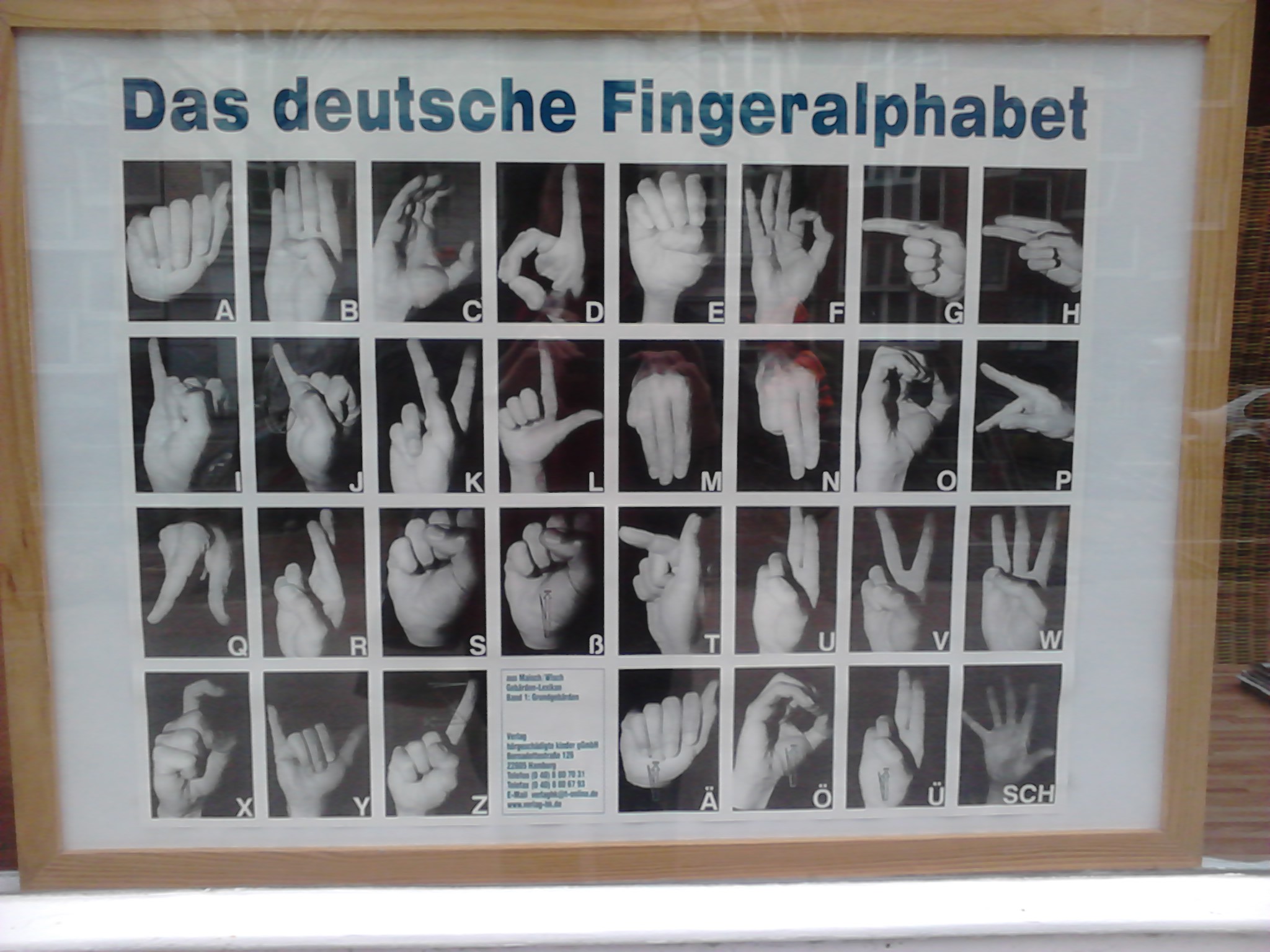
I was walking in a nearby neighborhood and noticed the poster with the German Finger Spelling Alphabet in a window. If you look at the images in the lower, you will see that they include the three umlaut forms, ä, ö and ü; the ß; and my favorite, sch since this combination is such a common one. While searching online, I discovered that some systems also include a ch, an nn and an mm; plus my favorite, the sch.

DSC_0119

Further searching revealed a Japanese Finger “Alphabet” which is more accurately termed a Finger Syllabery, as well as Russian, Greek and Norwegian varieties. With all of these you can let your fingers do the talking.

Tagged

Fahren mit dem Pfarrer?

Gestern in die Barmbek Dialog in Deutsch Gruppe redete ein polnische Mann über seine Jobs. Einer interessierte mich sehr, weil der Name ein Kompositum ist: »der Gabelstaplerfahrer.« Dieses Wort hat drei Teilen. Der erste Teil is »die Gabel« – the fork. Eine Gabel ist eine Art von Besteck. Die hat »Zinken« – prongs, normalerweise drei oder vier (übrigens, »der Zinken« bedeutet auch »eine große Nase« – wie schnozz auf Englisch, und auch »ein Geheimzeichen« – secret sign). Ein Stapler stammt aus das Wort »der Stapel.« Man kann ein Stapel Papier oder Holz oder Bücher haben. Viele ähnliche Dinge, dass man ordentlich sammelte, sind ein Stapel. Mit einem Stapler, ein Fahrzeug, kann man einfacher einen größeren Stapel machen. Der Stapler ist ein schriftlicher falscher Freund von stapler – »der Hefter.« Nur schriftlich, weil die Aussprachen nicht so ähnlich sind: deutsch /ˈʃta:plɐ/ und englisch/ˈsteɪpləʳ/. Ein »Gabelstapler« – forklift – ist ein bestimmtes Fahrzeug mit zwei Zinken vorne (wie eine Gabel). Schließlich kommt der Fahrer –  driver oder operator – jemand, wer das Fahrzeug operiert. Man kann ein »Fahrradfahrer« oder ein »Zugfahrer« oder ein »Busfahrer« oder »Taxifahrer« sein. Und natürlich auch ein Gabelstaplerfahrer!

Ich denke, dass »der Fahrer« und »der Pfarrer« ein bisschen ähnlich klingt. Deswegen dachte ich über einen »*Gabelstaplerpfarrer.« Vielleicht könnte er ein Mann sein, wer seine Predigt dick auftragen?

Tagged , , , , , , , , ,

Special Word Supplement?

I’ve started reading a translation by Michael Hofmann of Joseph Roth’s collection of short essays about Berlin – What I Saw: Reports from Berlin, 1920-1933 – and in it I learned a new English and German word “feuilleton”/das Feuilleton. This word seems apt to describe many of the pieces one will find in the blogosphere as it can mean “a cultural critique or review,” “a serial story column” or “a supplement” and typically the style is a personal one, light and humorous/ironic in tone, with the writer’s presence and opinions being part of the story. The content can be anything current that interests the writer, with perhaps particular attention to the goings on about town (e.g., the Talk of the Town feature of the New Yorker magazine).

Interestingly, as the Jewish Roth exiled himself to Paris following the rise of Adolf Hitler (a fellow Austrian), this piece in German from a Dickinson College Wiki mentions how the feuilleton was used as part of the Nazi propaganda machine, in part for fomenting antisemitism.

Tagged , , , ,

Louse-y old plurals

Today I needed to go to the Apotheke (“pharmacy, chemist or drug store”) in order to buy something to get rid of head lice – Kopfläuse – after finally realizing that they were what was making my head itch (this article helped me to figure out what to do). This got me pondering words where there is exclusive, or near exclusive use of either the singular or plural form. For instance, we rarely have reason to use the word louse in the singular when referring to the insect form. Contrariwise, you can’t really say about a group of disagreeable people that they are “lice,” the way you can use “a louse” to describe a single disagreeable person. (As an aside, “lice” is also interesting because it is an irregular English plural, although many lists include only its irregular sibling with a similar transformation: from singular “mouse” to plural “mice.”)

Canoo.net gives a list of four types of nouns that are normally only used in German in the singular:

Materialsdie Baumwolle, der Regen, das Kupfer – “cotton,” “rain” and “copper.” Sometimes plurals are formed from this type of word by adding a suffix – die Lederarten or die Tabaksorten, “the leathers” and “the tobaccos.”

Collectives: das Obst, das Gepäck – “fruit” and “luggage.” We can say “fruits” in English, however “luggage” exists only in the singular form as in German.

Abstractions: der Neid, die Kälte, das Glück – “envy,” “the cold,” and “luck.” “Envy” and “luck” appear only in the singular in English, as does “cold” when the meaning is a sort of weather/air temperature; one can talk about “colds” when the topic is a runny nose.

Proper names: (das) Amerika, der Rhein – “America” and “the Rhine” (river), the former can be used in the plural in English as in “potatoes are originally a food of the Americas” but this form is rare.

Canoo.net also offers a list of nouns found exclusively in the plural in German:
Place namesdie Azoren, die Pyrenäen and die USA – “the Azores” (island group), “the Pyrenees” (mountain group) and “the USA” (country name).

Groups of people: die Geschwister, die Leute – “the siblings” and “the people,” In English, we can say “sibling” and “people” is considered to be on of the plural form of “person” and is more commonly used than “persons.” German also has the word die Person which has the seldom used plural die Personen.

Collectives: die Kosten, die Fünfzigerjahre – “the expense, cost, expenditure” and the 1950s or “fifties.” The three translations of die Kosten are singular in English and have regular plural forms; decades appear only in the plural.

Diseasesdie Masern, die Pocken, die Röteln – “measles,” “smallpox,” “rubella.”  “Measles” serves as both the singular and the plural form; and “smallpox” and “rubella” exist only in the singular in English.

Otherdie Ferien, die Jeans – “vacation, holiday” and “jeans.” The former can be either singular or plural; the latter, like “glasses/spectacles” and “pants” appears only in the plural.

To end, here’s a poem (online source to see an English translation click here) that includes commentary on social class, friendly advice and a wish for deeper awareness of how we are seen by others – a wish that might not be shared by our conversation partners as we struggle to communicate with them in German!

To A Louse
by Robert Burns

[On seeing one on a lady’s bonnet, at church.]

Ha! whare ye gaun, ye crowlin ferlie!
Your impudence protects you sairly:
I canna say but ye strunt rarely,
Owre gauze and lace;
Tho’ faith! I fear, ye dine but sparely
On sic a place.

Ye ugly, creepin, blastit wonner,
Detested, shunn’d by saunt an’ sinner,
How dare ye set your fit upon her,
Sae fine a lady!
Gae somewhere else, and seek your dinner
On some poor body.

Swith, in some beggar’s haffet squattle;
There ye may creep, and sprawl, and sprattle,
Wi’ ither kindred, jumping cattle,
In shoals and nations;
Whare horn nor bane ne’er daur unsettle
Your thick plantations.

Now haud you there, ye’re out o’ sight,
Below the fatt’rils, snug an’ tight;
Na, faith ye yet! ye’ll no be right
‘Till ye’ve got on it,
The vera tapmost, tow’ring height
O’ Miss’s bonnet.

My sooth! right bauld ye set your nose out,
As plump and grey as ony grozet;
O for some rank, mercurial rozet,
Or fell, red smeddum,
I’d gie you sic a hearty doze o’t,
Wad dress your droddum!

I wad na been surpris’d to spy
You on an auld wife’s flannen toy;
Or aiblins some bit duddie boy,
On’s wyliecoat;
But Miss’s fine Lunardi! fie!
How daur ye do’t?

O Jenny, dinna toss your head,
An’ set your beauties a’ abread!
Ye little ken what cursed speed
The blastie’s makin’!
Thae winks and finger-ends, I dread,
Are notice takin’!

O wad some Pow’r the giftie gie us
To see oursels as others see us!
It wad frae mony a blunder free us,
An’ foolish notion!
What airs in dress an’ gait wad lea’e us,
And ev’n devotion!

The Poetical Works Of Robert Burns
Copyright 1910
Ward, Lock, and Co., Ltd
Tagged , , , , ,

Buchstabenspiele im Plural

Am Mittwoch haben wir über diese vier Wörter geredet, weil sie ähnlich klingeln:

»das Stadium« – state or stage (e.g., of a medical condition)
»das Stadion« – stadium
»das Studium« – studies or course of study
»die Station« – hospital ward or station (bus, train)

»Das Stadium« ist ein falscher Freund mit dem englischen Wort stadium (auf Deutsch »das Stadion«). Es stammt von Lateinisch und Griechisch. Seine Pluralform ist »die Stadien.« Über »das Stadion« hat Duden geschrieben: »griechisch stádion = Rennbahn, Laufbahn, eigentlich = ein Längenmaß (zwischen 179 m und 213 m); Rennbahn; ursprüngliche Bezeichnung für die 1 stádion lange Rennbahn im altgriechischen Olympia.« Seine Pluralform ist auch »die Stadien.« Das dritte, »das Studium,« stammt von Lateinisch und seine Pluralform ist »die Studien.« Schließlich, »die Station« stammt von Lateinisch und ist ein verwandt mit »stehen« und »stand.« Seine Pluralform ist ganz typisch und unterschiedlich als die andere: »die Stationen.«

Infolge dieses Studiums werden unsere Gruppenteilnehmer diese Wörter nicht mehr verwechseln!

Tagged , , , , , ,
Ray's Musings

Mostly Music Mixed With Miscellaneous Mayhem

virtuelles Migrationsmuseum

DOMiDs Blog zum Virtuellen Migrationsmuseum

Hamburg für Anfänger

Leben und (ver)lieben in Hamburg

Deutsch lernen mit Deutschlernerblog

Deutsch lernen - Hörverstehen, Leseverstehen, Wortschatz, Grammatik, Übungen, Prüfungen, Schreiben, Quiz, Musik, Videos, Bilder

a free state of mind

Thoughts from the Journey...

The Diversity Dividend

Doing Diversity Differently

Lirean

Smart language learning

Leading with Trust

Leadership begins with trust.

Akademie für geile Texte

Lasst mich schreiben. Dann wird alles gut.

Idol Musings

Ray's ruminations, rants and reflections on his American Idol addiction

The Elementalist Epoch

Stories and Poems from the mind of Tristan Nagler