Author Archives: kwhirsh

Wash and share

To be a “true blue” something is to be a waschechter something in German.

DWDS had a few examples of this in use:

ein waschechter Macho – “a true Macho” – yes, you can be A Macho in German (dict.cc offers “himbo” as a translation and this does capture the pejorative sense of the word).

eine waschechte Kulturstadt – “a true culture city” – perhaps best understood as being derived from the European City of Culture designation.

waschechten Mozartfans – “true Mozart fans” – it would seem that almost anything can be combined with Fan, as in English.

ein waschechter Verlagskontrakt – “a genuine publishing contract.”

When we take waschechter apart we get wasch – “wash” and echter – “more real,” “truer,” “more typical.” The waschechter combination can also mean “colorfast,” from which likely comes the implication that afforded the figurative use: that the characteristic is one that won’t “fade” or “disappear” (our own phrase “true blue” has this origin, coming from a time period where most blue dyes were fugitive). Intriguingly, in researching this I came across two phrases using gewaschen – Er ist mit allen Wassern gewaschen meaning “He’s a smooth customer” – and mit allen Wassern gewaschen sein – “to know every trick in the book” or “shrewd.” Which leaves me wondering what it might mean if you had washed everything in, say, Sekt or Chanel Number 5.

Tagged , , , , , ,

Spiel Spaß

Normalerweise schreibe ich auf Deutsch am Donnerstag. Diese Woche hatte ich zu viel zu tun. Folglich kommt es heute an. (Ich war versucht, das Wort »dementsprechend« zu benutzen, weil es das Wort dement drinnen hat. Aber habe ich niemals das Wort gehört.)

Bei der Dehnhaide Dialog in Deutsch Gruppe haben wir das Spiel »Opa planscht lustig in der Badewanne« gespielt. Wir haben ein ähnliches Wortspiel bei uns, aber ich weiß nicht der Name. Jeder hat ein Stück Papier. Erst mal, die Spieler schreiben ein Nomen (wie »Opa«) – eine Person oder ein Tier. Dann knicken alle Ihr Papier und zu dem nächtsten passen. Jeder schreibt ein Verb (wie »planscht«) und wieder die Papier knicken und passen. Demnächst kommt ein Eigenschaftswort (Adjektiv) oder Umstandswort (Adverb) (wie »lustig«). Und dann wieder knicken und passen. Danach schreiben alle ein Präpositionen (wie »in«), knicken und passen. Schließlich kommt ein andere Nomen, ein Ort oder Umgebung (wie »der Badewanne«). Man kann die Mitspieler mit seinem Wortschatz verblüffen versuchen!

Das macht viel Spaß! Wir haben ein Paar witzige Sätze geschrieben und dann lachen wir zusammen. Das macht spiel Spaß!

Tagged , , , ,

Cold cuts?!

Today in a conversation about preserving fish someone was searching for the word der Tiefkühlschrank and came up with the English word “freezer” /ˈfri:zəʳ/. Since the discussion was in German, I heard der Friseur /friˈzø:ɐ̯/ – “hairdresser.” Sometimes context just isn’t enough!

Tagged , , ,

Muffy the Survivalist

Monday night I had dinner with friends. Normally we would speak German, but for a change we were using English. At some point, one of my companions mentioned “preppies” and then in the next breath mentioned hoarding food and keeping a small arsenal and I began to suspect a cross-language mix-up was taking place. I asked him what was meant by “preppie” and he said something to the effect that it was someone who believed in “prepping” for the coming showdown with the US government. I did all I could not to laugh out loud at the confusion between “preppies” and “survivalists.” I was further surprised by his initial unwillingness to accept my statement that “preppies” were not  likely preparing for an apocalypse, but if they were, it would have been the fixings for G&Ts and Brooks Brothers button downs that they would have been hoarding (moreover hunting would be involved only through the ownership of some L.L. Bean duck boots).

Dict.cc does offer a couple of translations for the adjective “preppy,” namely adrett and popperhaft and mentions that it can refer to a style of dress or to someone who was a student at a preparatory school. It would appear, however, that “The Preppy Handbook” has not been translated (dict.cc will often mention book, film and song titles when a translation exists), depriving German speakers of the chance to appreciate idioms like “parallel parking,” “fruit loop” or “blow donuts” and nicknames like the eponymous Muffy and her pals Kiki, Skip and Missy.

Tagged , , , ,

Free reading

On my run tonight (dusk is coming much earlier now, sigh), I started to wonder about the many uses for the word frei because of seeing the Stadtpark Frelichtbühne – “open air stage/theatre(er)”  or literally “free light stage.” Dict.cc gives a large number of meanings for frei, including: “unengaged,” “at liberty,” “liberal” as in “not strict,” “clear,” “nonattached,” “blank,” “frank,” “allowed,” “idle” and “uncommitted.”
The “open air” family has several other members:
• das Freilichtkino – “open air cinema”
• das Freibad – “open air/outdoor swimming pool”
• die Freifläche – “open space” or “undeveloped land”
das Freilichtkonzert – “open air concert”

Frei is also a cognate of the English word “free.” Something that is frei is available at no cost (one can be more more specific and say that something is kostenfrei). In a related semantic field, there is the meaning of frei that corresponds to unabhängig –“independent” – which is a favorite word of mine as the Unabhängigkeitserklärung – The Declaration of Independence – was signed in my home town, Philadelphia.

Finally, one of the phrases I learned on my first trip to Germany in 1984 also uses freiIst dieser Platz frei? which means “Is this seat taken?” In this context frei means “unoccupied” or “not in use” or perhaps even “spare” if you intend to pick up the seat in question and take it to another location. I was delighted DWDS included this example sentence for the “available” or “spare” meaning of frei – Sie liest in jeder freien Minute, “She reads in every spare moment” – because it is so apt as far as I am concerned!


Tagged , , , , ,

Vokale Stolperstein (oder Stolperstain)

Heute habe ich eine Folge von Extr@!* auf Deutsch angeschaut und die schloss diesen Fehler ein:
    Ein Mann meinte «lächeln» /ˈlɛçl̩n/ — to smile — und er hat «hecheln» /ˈhɛçl̩n/ — to pant — gesagt. Der andere Mann hat gelacht.
Bemerken Sie, dass diese Paar gleich
klingt aber die ɛ-Laute sind buchstabiert unterschiedlich: ä und e. Deutsch hat nicht so viel buchstabieren Optionen als Englisch, sondern mehr als dies! Einige sind so häufig, dass sie Eselsbrücken haben. Zum Beispiel:
    Wenn «wider» nur «dagegen» meint dann ist «e» dem «i» stets Feind. Wenn «wieder» nur «noch einmal» meint dann ist das «e» dem «i» ein Freund.

Das Sprechen, wieder einmal, ist ein bisschen einfacher als das Schreiben, vielleicht probiere ich mein Blog als ein Vortrag zu entwerfen?!

____________________

* «Extra» ist ein einseitig Falschfreund, es bedeutet specially for you und intentionally außerdem extra und spare.

Tagged , , , , , , , , , , ,

What a difference a “d” makes

I’ve just noticed that “bedside” and “beside” are only one letter different…which led me to some interesting German phrases expressing the notion of being “beside ourselves.”

verworren sein –”to be beside oneself” or “to be discombobulated”
wirr sein – “to be beside oneself” or “to be muddled/confused”
Sie ist außer sich – “She is beside herself”
Sie war ganz außer Fassung – “She was completely beside herself” – Fassung is “composure” and “equanimity” and also “socket” which feels like it might somehow fit here, too…
Sie gerieten außer Rand und Band – “They were beside themselves” or “They were delirious”
außer sich vor Wut  – “beside onself with anger/rage”
außer sich vor Angst – “beside onself with fear”
außer sich vor Freude – “beside onself with joy” or “giddy with pleasure”
völlig/ganz aus dem Häuschen sein – “to be beside one’s self with joy” – Häuschen is “cottage”

Now, if only we could ensure that “bedside manner” always left patients “beside themselves” with joy rather than fear or rage…

Tagged , , , , , ,

Frightfully funny?

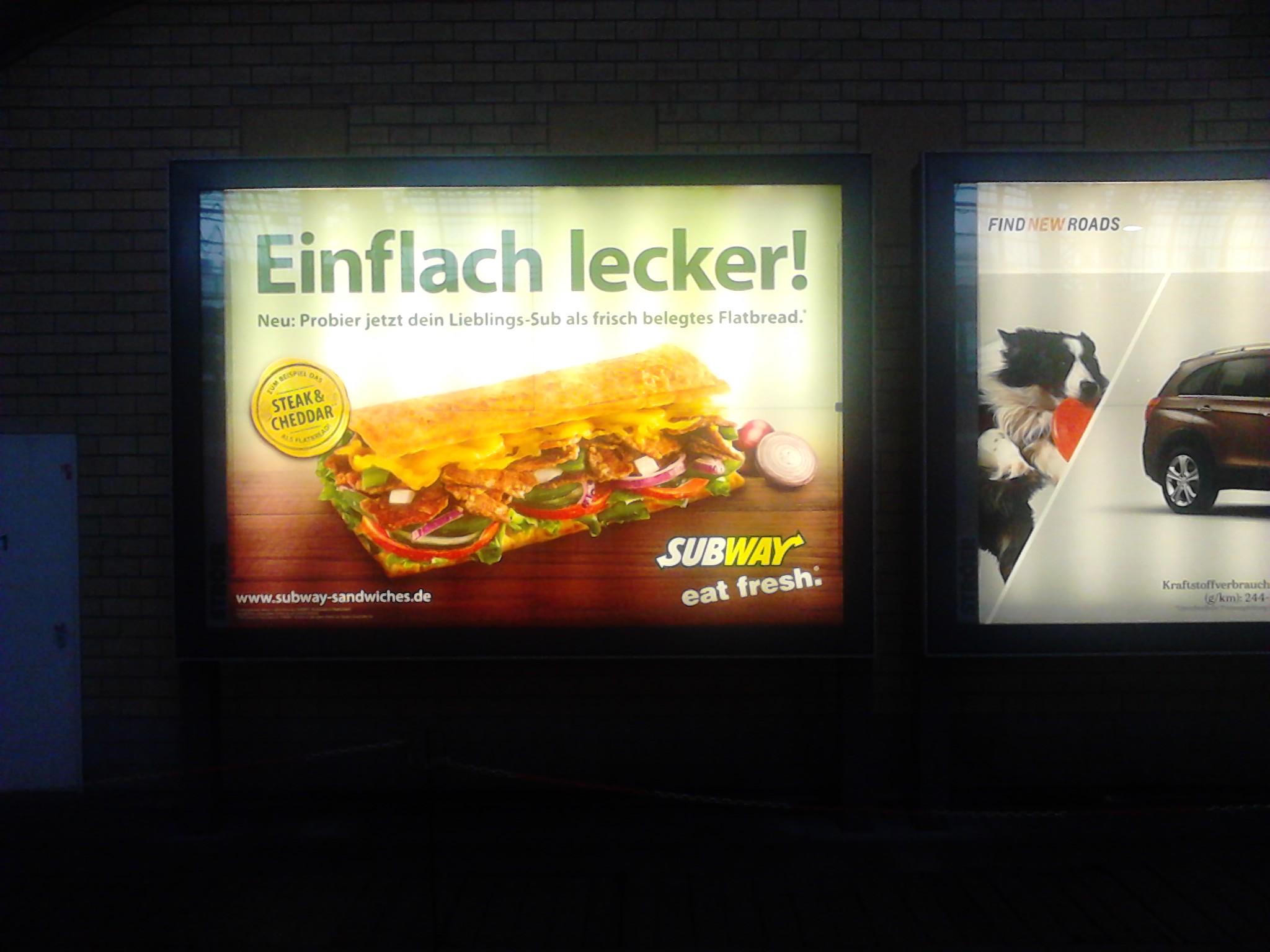
Today I saw an ad for Subway’s flatbread sandwiches which reads:

Einflach LeckerProbier jetzt dein Lieblings-Sub als frisch belegtes Flatbread
“***** 
Delicious! Now try your favorite sub as a freshly topped flatbread”

Einflach Lecker - Subway

Einflach Lecker – Subway

The asterisks designate the fact that einflach is not a real German word, it is a play on two of them: einfach and flach, “simply” and “flat.” A parallel construction in English would be something like “Shrimply Delicious” – a play on “simply” and “shrimp.”

It is simply wonderful to know enough German to appreciate words at play and reminds me of a joke (which I told at a Halloween party) that relies on you knowing the grammatical cases German uses:

»Weißt du, wie die drei Geschwister des Werewolfs heißen?«
»Nein, wie denn?«
»Da wärst du nie drauf gekommen: Sie heißen Weswolf, Wemwolf und Wenwolf…«

“Do you know the names of the Werewolf’s three siblings?”
“No, what are they?”
“Your never gonna guess! They are called Genitive-Who Wolf, Dative-Who Wolf and Accusative-Who Wolf…”

For this to even get off the ground, you need to know that wer is the German word for “who” in the nominative case, and that it is inflected in the other three cases to become weswem and wen. You also know from the order in which the names are given – nominative, genitive, dative, accusative – that this joke is not brand new as the cases are now more commonly ordered nominative, accusative, dative and genitive, perhaps reflecting the increasingly rare use of the genitive forms.

I hope this makes the case, once again, for German humor making ample use of wordplay.

Tagged , , , , , ,

Come on in, we’ve got air-condition

I’m visiting Prague this week and have been enjoying wandering around the city. I have run across a lot of German speakers and many of the restaurants have signs in German to lure in potential customers, thus in some ways it feels very much like home.  What I was also noticing was how many places were advertising air-condition. When I first saw this painted on the window at Les Moules, I photographed it, thinking it was a typo (what do you say when something wasn’t typed?!). However, closer inspection of additional restaurant windows revealed that air-condition is the Czech word for “air-conditioning.” Not quite as confusing as a “photo shoot” being called a Shooting or a “photographer” being called a Fotograf/in in German, but still enough to amuse me with thoughts of what the condition of the air is inside these spots!

Tagged , , , , ,

Confounded, Compounded

immerfort – “constantly” or “evermore” or “continually” or “timelessly”
DWDS.de says that this is a »Zusammensetzung mit immer, fort« or a compound of immer and fort.

Let’s take the second part of the compound, fort, first. Confound 1: Fort as a German adverb has two basic meanings – “away” (weg) and “further” (weiter) and through the second of these two meanings fort can also mean “constantly” when used in the phrase in einem fort as in Gestern hat mein Handy in einem fort geklingelt – “Yesterday my mobile/cell rang non-stop.”  Given this, immerfort seems a bit redundant, one could just use immer although perhaps the meaning wouldn’t be as intense (or fort!). Confound 2Fort is also a cognate of the English word “fort” – “fortified building.” This comes from Latin via Old French, with the Latin fortis meaning “strong.” Due to this, I have an image of my phone in a fort (what first came to mind was Clifford’s Tower in York! http://en.wikipedia.org/wiki/File:Cliffords_Tower_York_UK.JPG) when I read the sample sentence using in einem fort. Perhaps I need to think about Clifford’s Tower being a constant in York for hundreds of years?!

The first part of the compound, immer, is both an adverb and a particle. As an adverb it has several meanings. The primary way I use it is to mean “always,” however it can also mean “each/every time.”  Further, it can be combined with wannwas, werwie, and wo to mean “whenever,” “whatever,” “whoever,” “however” and “wherever” (sometimes the form is wann auch immer, etc.). It can also be used with a comparative adverb or adjective to mean something like “more and more” or “increasingly” or “ever XYZer” – immer größer or immer mehr. Thus far, it’s pretty straightforward, the confounding comes with the fact that immer has three particle forms (DWDS.de refers to particles as ohne eigentliche Bedeutung – or basically without a meaning of their own and using them makes you sound like a real German speaker for this reason, see also http://www.goethe.de/ges/spa/siw/en6370073.htm).  First of all, immer can be used to intensify noch as in Ist Dieter denn immer noch nicht zurück? – “Is Dieter still not back?” Now something “still” being true is a bit like it “always” being true, but for me this use is confounding because the expectation seems to be that the events being talked about are sort of surprising because they are not expected to stay as they are for all time (e.g., Dieter is likely to arrive at some point!).

The second meaning of immer as a particle is to modify a modal verb such as “can” in the phrase so schnell du immer kannst – “as fast as you can.” Pons.eu translates this meaning as “possibly” which again has some overlap with “always” but is also inconsistent with it in that you can rely on something that “always” happens, not so with something that only “possibly” happens. The third meaning of immer as a particle seems easier to illustrate with some idiomatic phrases than to define, they are mainly informal “commands” of some sort:

immer langsam voran! – “take your time!” or “not so fast!”
immer mit der Ruhe! – “take it easy!” or “calm down!”
immer weiter – “carry on” or “go ahead”

Which leaves me to wonder, could we combine the second and third phrases above to get something like “Keep calm and carry on” which one seems to see constantly these days?!
Tagged , , , , , , ,
Ray's Musings

Mostly Music Mixed With Miscellaneous Mayhem

virtuelles Migrationsmuseum

DOMiDs Blog zum Virtuellen Migrationsmuseum

Hamburg für Anfänger

Leben und (ver)lieben in Hamburg

Deutsch lernen mit Deutschlernerblog

Deutsch lernen - Hörverstehen, Leseverstehen, Wortschatz, Grammatik, Übungen, Prüfungen, Schreiben, Quiz, Musik, Videos, Bilder

a free state of mind

Thoughts from the Journey...

The Diversity Dividend

Doing Diversity Differently

Lirean

Smart language learning

Leading with Trust

Leadership begins with trust.

Akademie für geile Texte

Lasst mich schreiben. Dann wird alles gut.

Idol Musings

Ray's ruminations, rants and reflections on his American Idol addiction

The Elementalist Epoch

Stories and Poems from the mind of Tristan Nagler