Author Archives: kwhirsh

Ein Neid-Leid ist kein Nacht-Licht

Ich finde die Reihe Philosophieren mit Neugierigen Kindern ganz gut. Gestern habe ich von Zusammenleben: Was ist das? ein Paar Wörter gelernt. Interessanteste war »der Neid« und sein Wort- und Ausdruckfamilien.

Das Wort klingt ähnlich wie das englisches Wort night (»die Nacht«): /nait/ und /naɪt/. Ein falscher Freund! Das erinnere ich mich an das Wort »das Leid« (distress). Es klingt ähnlich wie das englisches Wort light (»das Licht«): /lait/ und /laɪt/.

Auf English kann man sagen, dass jemand »grün vor Neid« – green with envy – ist. Man sagt das auf Deutsch auch und außerdem »gelb vor Neid« (die Farbveränderung ist ein bisschen wie black and blue und »grün und blau«). Und wo wir to become/turn green with envy sagen, die Deutsche sagen, »vor Neid erblassen« – wörtlich to become pale with envy. Zum Schluß ist der Ausdruck »der Neid der Besitzlosen.« Die Übersetzung ist sour grapes, wörtlich »sauere Trauben.« Die Bedeutung des englisches Ausdrucks ist nicht so einfach zu verstehen als der deutscher (worüber Google Translate envy of the have-nots anbietet). Der Ausdruck stammt aus der Fabel von Aesop: Der Fuchs und die Trauben. Im de.wikipedia.org habe ich diese Gedicht von Karl Wilhelm Ramler gefunden.

Ein Fuchs, der auf die Beute ging,
fand einen Weinstock, der voll schwerer Trauben
an einer hohen Mauer hing.
Sie schienen ihm ein köstlich Ding,
allein beschwerlich abzuklauben.
Er schlich umher, den nächsten Zugang auszuspähn.
Umsonst! Kein Sprung war abzusehn.
Sich selbst nicht vor dem Trupp der Vögel zu beschämen,
der auf den Bäumen saß, kehrt er sich um und spricht
und zieht dabei verächtlich das Gesicht:
Was soll ich mir viel Mühe nehmen?
Sie sind ja herb und taugen nicht.

Mein Gesichtsausdruck ist selten sauer, weil ich deutsch lernen genieße und jetzt wir was der Fuchs sagt sagen können !
Tagged , , , , , ,

Less Tension from Declension?

How’s this for a memory aid (eine Eselsbrücke)? 
For the articles and adjective forms for the Dative case with definite articles recite:

Two dems (dames) der (dare) a den (Dane) to a definite dativ (date); they’re all –en (in)

   Masculine definite article dative case: dem 
   Neuter definite article dative case: dem
   Feminine definite article dative case: der
   Plural definite article dative case: den

When these articles are followed by an adjective, that adjective takes an n/en ending.

Jemand muß dem armen verzweifelten englischsprachigen Mann helfen.
Jemand muß dem armen verzweifelten englischsprachigen Kind helfen.
Jemand muß der armen verzweifelten englischsprachigen Frau helfen.
Jemand muß den armen verzweifelten englischsprachigen Studentinnen helfen.

Perhaps this little mnemonic will be of some help for some other poor and desperate English speaking person, at least when trying to use the dative case with a definite article with verbs like helfenpassen and danken?!

Tagged , , , , , , , ,

I’ll take a receipt with that tree…

On Thursday I made the mistake of doing some shopping, along with a ton of other Hamburgers, and when my turn came I was thrown by the simple question Tüte dazu? – “A bag for/with that?” Being left speechless doing simple transactions is nothing new, however it prompted me to look up another word that I •thought• I was hearing during transactions: *Kassenbaum. Why a combination of die Kasse – “till, checkout or cash register” – and der Baum – “tree” – had made sense to me, given German compound nouns are usually quite logical, is quite puzzling!  Of course, the word I was hearing is der Kassenbon, so perhaps I can excuse my mishearing given the second noun in the compound, der Bon, is taken from French and pronounced as either /bɔŋ/ – a bit like the English word “bong” – or /bõ:/ – which with its nasalization has no English parallel unless, as in this case, you count loanwords from French.

Tagged , , , , , ,

Ein Pferd vom Feld schicken?

Ein Bekannter aus Ungarn hat heute uns Spargel Landwirtschaft beschrieben.  Er hat das Wort »Feld« (fieldsehr oft gesagt und fast immer habe ich das Wort »Pferd« (horse) gehört. Ja klar, das Pferd steht normalerweise in dem Feld, aber man kann nicht Spargel auf einem Pferd wachsen!

 DieseWörter klingt ähnlich bei mir:
   Pferd /pfe:ɐ̯t/
   Feld /felt/

 Die Laute/p/ mit /f/ und /f/ allein sind ziemlich schwierig zu unterscheiden. Zusätzlich sind der Laut /r/ und der Laut /l/ manchmal auch schwierig zu unterscheiden. Es gibt viele Geschichte über Leute verwechseln /l/ und /r/, weil beide Fließlaute oder Liquida sind. Meistens sind die Geschichte über keine Amerikanerinnen – aber es gibt für alles ein erstes Mal!

Tagged , , , , , , , ,

Hyphe-nation?

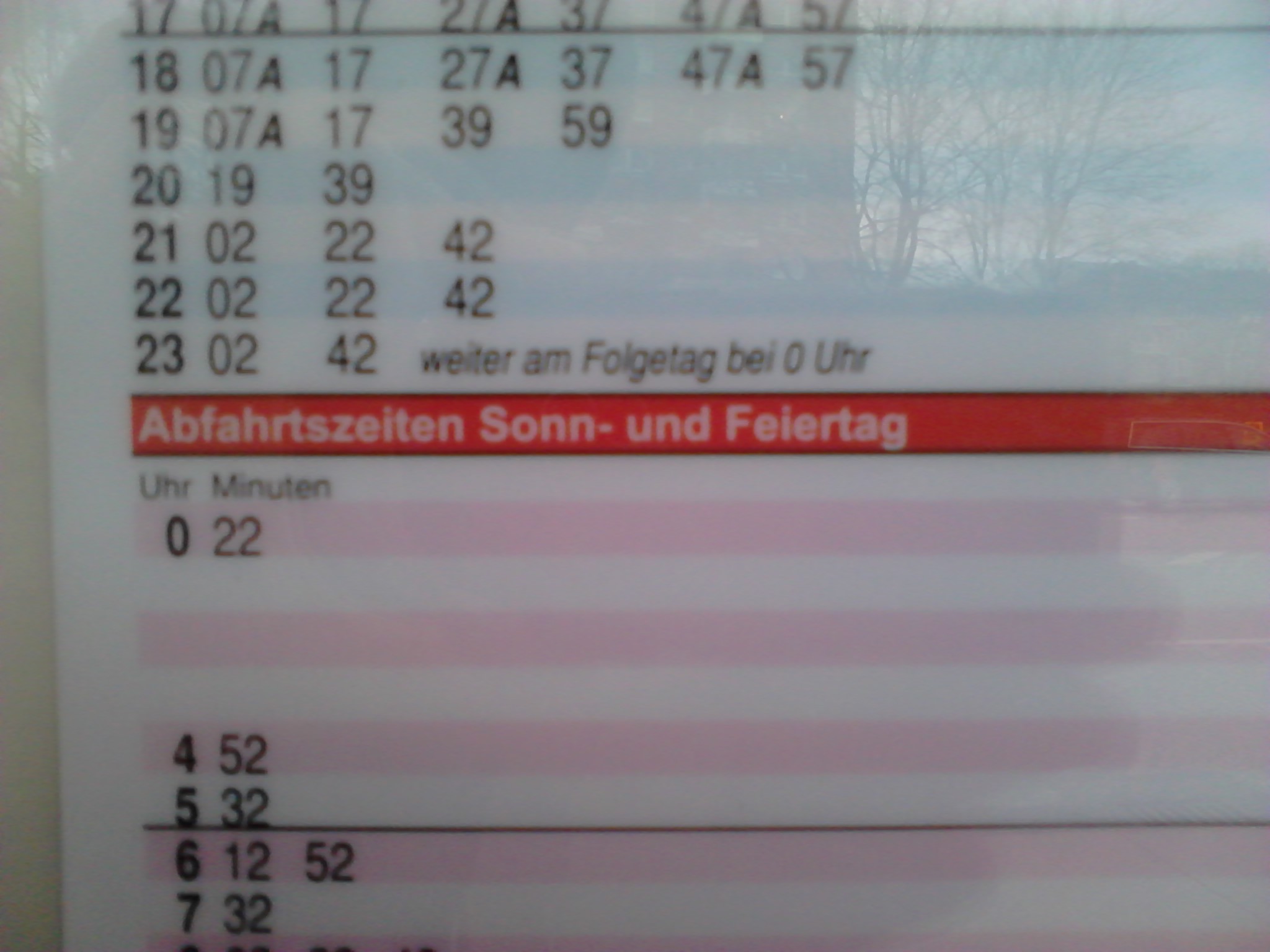
Since we are in the midst of a period of special transit schedules due to the holidays, I’ve been paying particular attention to the signs posted in bus shelters, etc.

DSC_0096

What I had failed to notice previously is that the times for Sundays and holidays are listed under the heading Sonn- und Feiertag. Two things struck me immediately. First, I don’t recall ever seeing a schedule where Sunday, or any other day for that matter, was listed as “Sun-” if it was followed by “and” and the name of another day. I also don’t think that English speakers are very aware of the “Sunday-Holiday” connection via both including the word “day.” Second, and I’m only going by memory, but I’d expect North American bus schedules to read “Sundays and Holidays” rather than “Sunday and Holiday” which would be the literal translation of the German used on the sign in the picture above.

“Tiny” words that get no bigger

Yesterday I was discussing how to form the plural of das Kaninchen – “rabbit.” This discussion began because this word, and a picture of a rabbit, appears on the cover of the Pixi book Unsere Tiere: Ein Bestimmungsbuch – Our Animals: A Field (Classification) Guide – and unfortunately for German learners, the cover is the only place where the definite article appears. (This seems a bit ironic given the book’s title includes a compound with die Bestimmung, a word from the same family as the adjective bestimmt, since the “definite article” is a bestimmter Artikel.) Bob joked that we would simply have to use the definite plural – die – all the time which got us wondering how the plural for –chen words was formed.

A quick check with dict.cc showed that several sample –chen words (that we’d been discussing on another day because of their pronunciations) – das Stäbchen and das Mädchen (“chopstick” and “girl”) – had null plurals. Immediately, a new hypothesis came to mind, perhaps both of the major diminutive forms –chen and –lein – have null plurals? I investigated this with das Buchlein and das Fräulein (“booklet” and “unmarried woman”) and it appeared to hold true. A quick search today led me to this page on the German for English Speakers site. It shared two facts that I already knew about the two big German diminutives (pun intended): they take das as a definite article and they often trigger an umlaut during conversion. It also confirmed the new idea that their singular and plural forms are identical.

I have to say I love a rule that tells you to do absolutely nothing to signal a grammatical change, such rules seem rather few and far between in German!

Tagged , , , , , , , ,

Like Night and Day?

Here in Hamburg we’ve just celebrated Heilige Abend and Weihnachten – three days of festivities in all. Take apart that latter word, which we could translate as “Christmas,” and you get weih and nachten. The first part comes from the verb weihen which means “to consecrate” as in to make something holy or when used about a person a better translation would be “to ordain.” The second portion comes out of Middle High German where the plural for die Nacht – “night” – was not die Nächte as it is today but nahten. I find it intriguing how in English the holiday on the 24th is associated with evening – “Christmas Eve”- but typically we refer to the 25th as “Christmas Day” rather than “*Christmas Night.” Moreover, only one day is referred to – it isn’t “*Christmas Days.” If the 26th is a celebration, it is called “Boxing Day” (for more on that, see this Wikipedia entry).

Copperheads?

Today’s creatively confused mishearing was Kupfer /ˈkʊpfɐ/ “copper” instead of Köpfe /ˈkœpfə/ “heads.” The former made no sense in the context but (a) I’d heard and said it before and (b) it is an interesting word as it moved away from its Latin roots – cuprum- with German spelling reform.

Der Kopf is the source of a number of idioms, just as it is in English. The interesting ones for me in this instance are those where there is a semantic similarity that in some way mirrors the phonological similar of Kupfer and Köpfe. For example, in English we say “neck and neck” – perhaps two horses in a race or two programs with an equal chance of winning something or to use a different set phrase “to be in a dead heat” – and in German the expression is Kopf an Kopf (which PONS tells me can also be translated as “shoulder to shoulder”). Now to me, “head to head” means something different to “neck and neck” in that while there are still two parties involved, they are somehow “facing” each other, from two sides of an argument or two sides meeting each other in a sporting event, rather than “alongside” each other as “neck and neck” seems to require. Indeed, PONS offers gegeneinander antreten – which can also mean “meet” – as a translation for “head to head.”

Another example where the shades of meaning could trip you up is bis über den Kopf. According to PONS this should be translated “up to one’s neck/ears” but it looks very much like “in over [one’s] head.” It is certainly possible that something where you are “up to your ears” might also be something where you are “in over your head” but this is not necessarily true (e.g., you can be “up to your ears” in something like paperwork, which isn’t too challenging, but there is a heck of a lot of it). In line with this difference, “in over one’s head” can be rendered in German in at least two ways, one fairly literal and the other figurative:
   • einer Sache/Situation nicht gewachsen sein – “to be unable to cope with something/a situation”
   • kein Land mehr sehen können – “to no longer be able to see  land”

Such are some days in the life of a German learner and for Hamburg dwellers in particular,with the omnipresent harbor, the concept of not being able to see land seems particularly apt to describe the feeling one often has in trying to master the language!

Tagged , , , , , , , , , ,

Machtspiel-los?

Heute habe ich eine B2B Messe besucht. Eine Freundin von mir hat einen Vortrag über Stress gehalten. Sie sagte uns, »Was oder wer macht Stress?« Eine Frau sagte, »Entscheidungen treffen.« Eine andere, »zu viel Termine.« Und ein Mann sagte, »drohender Schaden.« Schließlich eine andere Freundin von mir sagte, »Ohnmacht.« Dieses letztes Wort habe ich niemals gehört. Ich dachte nach, was das Wort wohl bedeutenmöge. »Ohn« sieht wie »ohne« aus und »macht« ist eine Form von »machen.«

Also dann, meine Freundin hat mir erst einmal gesagt, “literally, unconsious but in this case something more akin to powerlessness.” Nun habe ich das Wort bei dict.cc nachgelesen. Der erste Eintrag ist faint, danach faintingswoon, blackoutpalsy und syncope (alle hat die Auszeichnung der Begriffe als Medizin). Dann kommt powerlessness und impotence. Interessant ist dass, das Wort mit diesen letzten zwei Bedeutungen kein Plural und kein Artikel hat. Die Medizinbedeutungen Wörter nehmen »die.«

Wann man sich der Ohnmacht nahe fühlt, hat man auch Stress? Und wenn man sein Selbstbewusstsein nur schwach sehen kann, kommt dann auch Stress, oder?

Tagged , , , ,

Sehen Sie Meer und See Mehr

Noch eine Werbung mit einem Homofon

Fliegen Sie Meer

Fliegen Sie Meer

Man kann der Ton /e:/ mit »eh« oder »ee« buchstabieren. Auf Englisch sagen wir vielleicht See more of the world.


Tagged , , , ,
Ray's Musings

Mostly Music Mixed With Miscellaneous Mayhem

virtuelles Migrationsmuseum

DOMiDs Blog zum Virtuellen Migrationsmuseum

Hamburg für Anfänger

Leben und (ver)lieben in Hamburg

Deutsch lernen mit Deutschlernerblog

Deutsch lernen - Hörverstehen, Leseverstehen, Wortschatz, Grammatik, Übungen, Prüfungen, Schreiben, Quiz, Musik, Videos, Bilder

a free state of mind

Thoughts from the Journey...

The Diversity Dividend

Doing Diversity Differently

Lirean

Smart language learning

Leading with Trust

Leadership begins with trust.

Akademie für geile Texte

Lasst mich schreiben. Dann wird alles gut.

Idol Musings

Ray's ruminations, rants and reflections on his American Idol addiction

The Elementalist Epoch

Stories and Poems from the mind of Tristan Nagler