Author Archives: kwhirsh

Are You Experienced?

I’ve been puzzling over two words that both can be translated as “experience” – das Erlebnis and die Erfahrung. I learned the first of these early on as I wanted to be able to describe my “experiences” with living in Germany and this word seemed to fit. Recently, I have been doing some online exercises about the German educational system and one of the key words that came up was die Erfahrung. As in English, this can be a section on one’s CV/resume (der Lebenslauf – worth a post in itself!) where you describe the different jobs, paid and unpaid, that you have done. Two German friends seemed surprised that I would find these two words confusing, they argued that die Erfahrung is associated with learning something new. In support of this they cited the proverb durch Erfahrung wird man kluge – “one learns by experience” or perhaps “through experience one becomes wise.”

My current hypothesis, based on this explanation, is that while you may set up the conditions that produce ein Erlebnis – going on a vacation or to a new restaurant or for a walk in the park – the “experience” just happens to you, you are somewhat passive. For it to be eine Erfahrung, you must put in some sort of effort, you don’t simply collect these “experiences,” you build them.
Tagged , , , , ,

What a Difference a G Makes

One of my fellow Dialog in Deutsch participants works as a live-in carer for an elderly woman with dementia. She is a Betreuerin. In a novel I was reading, one of the characters set up scams to get people, perhaps elderly and with dementia, to part with their money. She is a Betrügerin. While there is a vowel difference in the second syllable – /ˈtrɔy/ vs. /ˈtry:/ – this is rather subtle for the non-native ear, and thus that G becomes quite important to distinguish whether someone is being helpful or doing something harmful.

According to the Wortbildung analysis on canoo.net, betreuen is formed from the prefix be and the adjective treu – “faithful” or “true” – and betrügen is formed by adding be to the verb trügen – “to deceive” and gegenteil-von.com gives treu sein as the opposite of betrügen!

Tagged , , , , ,

Composing Word Play?

I’m working my way slowly through Anekdoten, Legenden und Sagen and today’s chapter concerned J.S. Bach. I was delighted to learn that Beethoven used a bit of wordplay to describe Bach that I think would delight a modern advertiser or marketeer:

»Nicht Bach – Meer soll er heißen, Meer

Ein Bach is “a stream” in addition to being the composer’s name, thus given what a “big” composer he was, his name ought to call out something equally big such as an “ocean” or ein Meer. Perhaps we should return the favor and upgrade Beet-hoven from his “patch” – das Beet – to at least a” field” and make him Ackerhoven!

Tagged , , , , ,

Brush up on your Dickens?

It made me laugh today when I was doing some sweeping because the word fegen – “to sweep [with a broom]” – is pronounced very much like the name of the Dickens’ character “Fagin” from the novel Oliver Twist. And why is this funny?! Because dict.cc includes the entry die Straße fegen for which it gives the translation “to scavenge the street.” Perhaps this derives from the less common meaning of fegen –”to move fast” or schnell fahren – as in this sentence from Pons.eu Er kam um die Ecke gefegt – “He came tearing around the corner.” While I did make short work of the sweeping, I wouldn’t describe it as “tearing through” this task and I also failed to scavenge anything in my “Fagin.”

Tagged , , , ,

Breaking Up Is Hard to Do

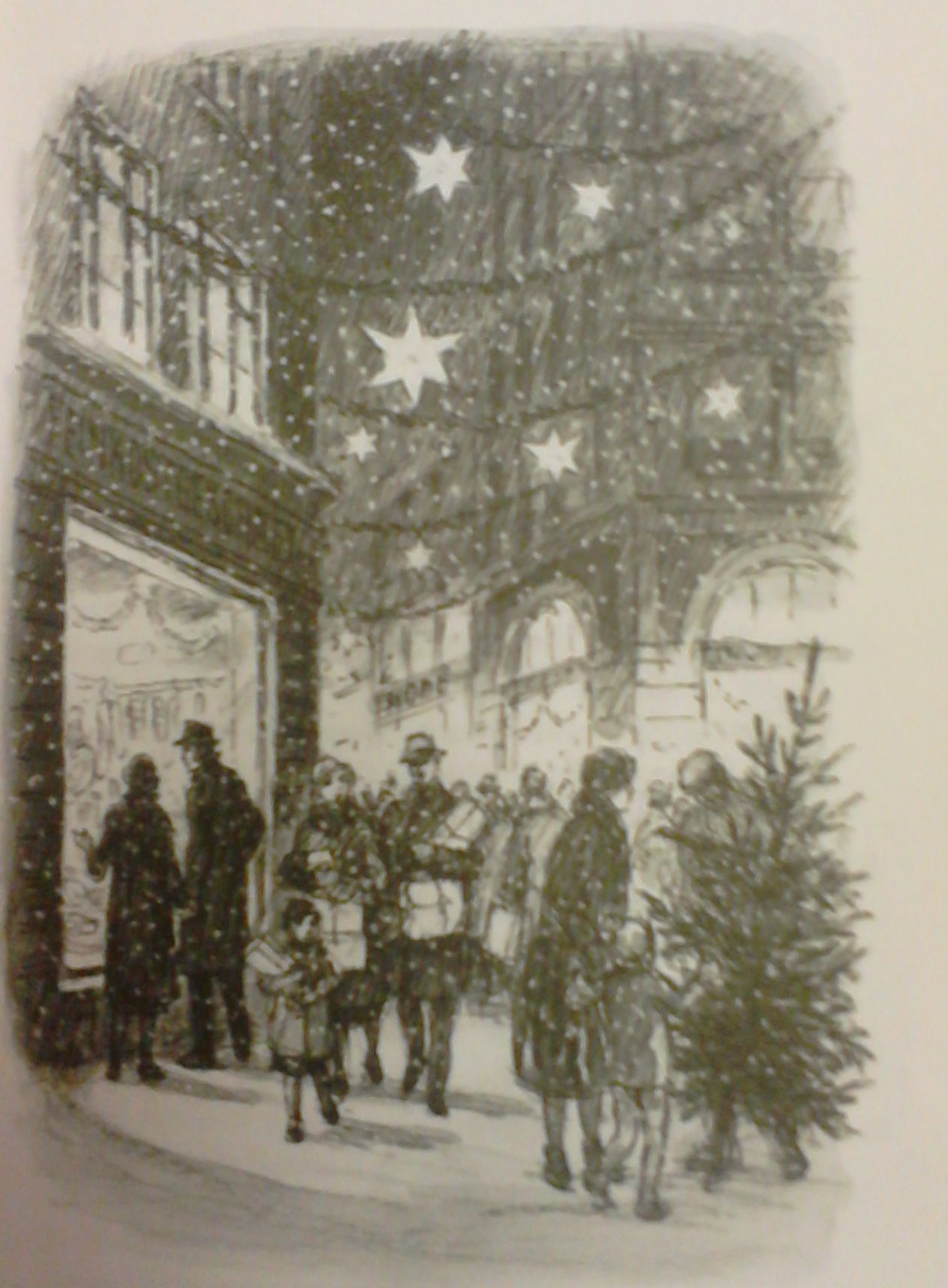
I am reading a simplified version of Hans Fallada’s »Erzählungen« and this illustration helped lead me astray in the syllabification of an unknown word: die Schaufenstern. Because, in addition to there being a large Schaufenster – “shop window” – at the left of the image, there are also a number of Sterne – “stars.” Now if I’d be paying closer attention to the word’s spelling, I would have noticed that since the plural of der Stern is die Sterne, the word was not indicating a sort of star – Schaufenstern as I was initially syllabifying it – but instead signaling the presence of a several of a specific type of window – Schaufenstern!

Schaufenstern

Tagged , , , , , , , ,

Less and more certain?

wahrscheinlich – “probably”

wahr sein – “to be true”

scheinen – “to seem”

I’d known the word wahrscheinlich for awhile, but yesterday doing some exercises that included both wahrscheinlich and wahr sein helped me to see how the former word was constructed.  Something that is “probable” is likely something that “seems true.” Put wahr and scheinen together, a bit like wahr sein, and then tack on the -lich ending to create an adjective (this suffix is quit productive: http://www.canoo.net/services/WordformationRules/Derivation/To-A/Suffixe/lich.html?lang=en) and you’ve got “probably.”

Which reminds me to share with you a site I recently discovered where you can look up a word’s opposites: http://gegenteil-von.com What makes a word like wahrscheinlich interesting is that it has opposites that are both more and less certain. For example unwahrscheinlich –”improbable” or “unlikely” – and weit hergeholt – “far-fetched” – take us toward the uncertain end of the spectrum and bestimmt – “certain” – and definitiv – “definite” – take us toward certainty.

What’s clear is how delighted I was to discover the relationship between the word wahrscheinlich and its component parts!

Tagged , , , ,

Ohne Rauch kein Fehler?

Heute habe ich dreimal Dialog in Deutsch besucht. In der letzten Gruppe habe ich die Redewendung »Mir raucht der Kopf« gelernt. Dict.cc sagt, die Übersetzung ist My head is spinning. Dieser englische Ausdruck kann in zwei Richtungen gehen: »Mir ist schwindlig« und »Mein Kopf fließt über, weil ich furchtbar viel Informationen bekommen habe.«  Ich bin froh, diese Redewendung zu lernen, weil die ein Bespiel für ein Dativ Subjekt ist. Ich finde diese Art von Subjekt ziemlich seltsam:

»Mir ist kalt, heiß, oder langweilig« – I am/feel cold, hot, bored
»Das ist mir egal!« –  I don’t care/Whatever/It’s all the same to me!
»Das gefällte mir« – I enjoy that/That pleases me
»Das passt mir besser« – That suits me better
»Das schmeckt mir gar nicht!« –  I don’t like the sound of that at all!
»Tut mir leid« – Sorry/I’m sorry

Obwohl »Das ist mir egal« auf englisch mit einem Dative Subjekt (»mir« – to me) übersetzen kann (und vielleicht »Das gefällte mir«, wenn man das als That is pleasing to me übersetzt), die meisten würden am besten mit einem Nominativ Subjekt (»ich« – I) übersetzen. Damit der Kopf meines Komputers auch nicht raucht, sage ich Tschüs!

Divorced, Dead or Different?

Today during introductions, someone mentioned that they had just gotten married and that started a discussion about the difference between the words geheiratet and verheiratet. Both of these are past participles, from heiraten and verheiraten respectively, however verheiratet can also be used as an adjective and it is out of this difference that our discussion arose. Thus, one can say Ich bin verheiratet – I am married – but if you are trying to describe the event, say because it just happened as in this woman’s case, you need to say Ich habe am neunzehnte Januar geheiratet – “I got married on 19 January” – and not Ich war am neunzehnte Januar verheiratet, as the latter implies that between then and now you ceased to be married – “I was married on 19 January (but now I am not).” An extra added twist is that the non-reflexive verb verheiraten means “to marry someone off;” if you want to talk about your own marriage, you need to use the reflexive form sich (mit jemandem) verheiraten Ich habe mich am 19 Januar verheiratet. (Note that sich verheiraten and verheiraten [and heiraten] both take haben in the past tense, therefore you have another clue to use when trying to decide whether verheiratet is being used as an adjective or a past participle.)

If this wasn’t enough confusion, what popped into my head was how different the relationship was between geschieden and verschieden: Ich bin geschieden – “I am divorced” – and Ich bin verschieden – “I am different.” Although verschieden is the past participle of verscheiden, it is very unlikely to be interpreted in this way as verscheiden is a polite or euphemistic form of the verb “to die.”

Tagged , , , , ,

Success by Going With the Flow?

die Leistung – “performance, achievement, accomplishment”
die Leitung – “conduct, administration, line” (as in conduit or pipe) compare Leitung einer Firma, “direction of a company” and Leitung einer Flüssigkeit, “conduction of a liquid”

I’d used the second word to be very North American and order tap water in a restaurant – Leitungswasser – and upon learning its near sound alike, die Leistung, I immediately wondered what you would get if you ordered “performance water?”

Tagged , ,

Of Owls and Spoons

Last week we were discussing Redewendungen – “idiomatic expressions” – and the phrase die Suppe auslöffeln was one that I had previously heard. Literally it means “to eat up all of the soup” but the figurative meaning can be translated as “to face the music” or “to face the consequences” – die Konsequenzen/Folgen tragen. This led me to other phrases including the verb tragen, some of which feel quite natural in English, others less so. Prior to learning the idiom die Suppe auslöffeln, I’d used this verb mainly in the sense of “wearing” something as in “to wear a coat” – einen Mantel tragen. Here are some expressions and saying that extended the meaning of tragen for me:

“to carry a trunk” – einen Koffer tragen
“to bear a name” – einen Namen tragen
“to pay for itself” – sich selbst tragen

“to grin and bear it” – es mit Fassung tragen (“to bear something with composure”)
“to bring coals to Newcastle” – Eulen nach Athen tragen (“to take owls to Athens” – the owl is the symbol of Athena and appeared on Athenian coins)
“to wear one’s heart on one’s sleeve” – das Herz auf der Zunge tragen (“to wear your heart on your tongue”)

In addition, there is a related word, übertragen, that is part of the expression for the figurative meaning of a word – die übertragener Bedeutung – which perhaps could be translated as the meaning “carried above” the actual words?!

Hope I haven’t “worn you out” with all of these (which I might have done if I had covered all of the possible translations dict.cc gives for “worn out,” abgetragen among them)

Tagged , , , , , , , , , ,
Ray's Musings

Mostly Music Mixed With Miscellaneous Mayhem

virtuelles Migrationsmuseum

DOMiDs Blog zum Virtuellen Migrationsmuseum

Hamburg für Anfänger

Leben und (ver)lieben in Hamburg

Deutsch lernen mit Deutschlernerblog

Deutsch lernen - Hörverstehen, Leseverstehen, Wortschatz, Grammatik, Übungen, Prüfungen, Schreiben, Quiz, Musik, Videos, Bilder

a free state of mind

Thoughts from the Journey...

The Diversity Dividend

Doing Diversity Differently

Lirean

Smart language learning

Leading with Trust

Leadership begins with trust.

Akademie für geile Texte

Lasst mich schreiben. Dann wird alles gut.

Idol Musings

Ray's ruminations, rants and reflections on his American Idol addiction

The Elementalist Epoch

Stories and Poems from the mind of Tristan Nagler